

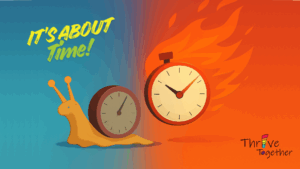
It’s About Time!
In his book Felt Time, Mark Wittmann explores a fascinating truth: our perception of time is not fixed. It stretches or contracts depending on the depth of our experiences. A joyful hour can feel fleeting, while a difficult one can feel endless. Time, in other words, is not just measured by the clock – it is measured by how we live it and feel it.
This idea resonates powerfully when we reflect on post-apartheid South Africa. Thirty years have passed since 1994, yet how those years have felt and are perceived depends on where we stand:
- For some, 30 years feels like a painfully long time ago: “After three long decades, how can we still be here? Still striving like this?”
- For others, 30 years ago is a simple marker: “Apartheid was long ago, we’ve moved on, why are we still talking about it?”
Both perspectives are valid, because they reveal the complexity of lived experience. Progress, or the lack thereof, shapes whether those years feel like healing or stagnation. For those who have benefited from transformation, time may feel abundant, even generous. For those still waiting for equity to reach their communities, workplaces, or schools, time may feel like it has barely moved at all.
The Unequal Weight of Time
 This divergence in perception is not just philosophical – it has real consequences. When one group insists that “we’ve moved on,” it risks erasing the ongoing struggles of those who continue to live with inequality. When another insists “we can’t still be here,” it highlights the urgency of unfinished work. These are realities of felt time.
In my own life, I see this tension vividly. My husband’s family still sits with the pain of land that was once theirs, now belonging to someone else as a result of their human rights being violated. They still carry the weight of knowing that money meant to compensate for his uncle’s death in police custody under apartheid remains locked in a bank account, never paid out to the family who lost their son, brother, uncle. For them, 30 years has not erased the injustice – it has only deepened the sense of waiting.
These stories remind us that democracy’s promise has not been felt equally. And they challenge us to ask: whose time are we living in?
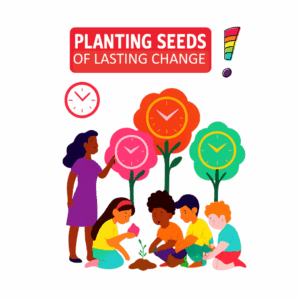 Looking Ahead: The Next 30 Years
The real question is not whether 30 years is “long enough.” The question is: How do we ensure the next 30 years are felt as years of shared progress, dignity, and hope?
Time is not just measured in years. It is measured in change. And the legacy we build now will determine whether future generations look back and say: “Those were the years when change truly took root.”
✨ The challenge before us is to make time felt not as waiting, but as becoming.
Why I’m Passionate About Thrive Together
This is why I am passionate about the Thrive Together curriculum. It is about equipping and empowering teachers to have real conversations with learners about our differences, our history, and our shared responsibility to intentionally write a different, better future.
Education is where felt time can shift – where the next generation can be given the tools not only to understand the past, but to imagine and build something new. By creating spaces for honest dialogue, we can ensure that the years ahead are not simply endured but actively shaped into years of progress and genuine hope.
A Call to Reflection and Action
As we stand today, we are invited to reflect on how time has been experienced differently across our society. But reflection alone is not enough. The next chapter must be written with intentionality:
- Equity must be tangible. Justice and change cannot remain abstract promises; they must be lived in everyday realities.
- Representation must be visible. The stories of those who have carried the weight of waiting must be amplified.
- Progress must be shared. The measure of success is not whether some have moved forward, but whether all have.
If felt time teaches us anything, it is that the years ahead will be remembered not by their number, but by their impact.
A Call to Action
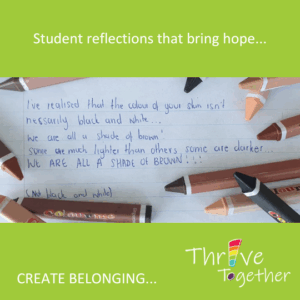 If we want the next 30 years to be remembered as years of becoming – years when change truly took root – then we must start in our classrooms. We must equip and empower teachers with the resources, skills, agency, courage, and support to create safe spaces and guide young people through the hard conversations about history, identity, and justice.
That is the work of Thrive Together. And it is work that matters.
So my call to you is this: let’s champion curricula that don’t shy away from our past but instead use it as the foundation for a more equitable future. Let’s invest in schools as the place where felt time shifts from waiting to way-making.
Because when our children thrive together, our future does too.
Closing Thought
Thirty years of democracy have taught us that time is experienced differently depending on where we stand. The next thirty years must teach us something greater: that time, when shaped by justice, education, and transformation, can be felt as hope fulfilled.
And perhaps, when future generations look back, they will say: “Those were the years when change truly took root.”


